
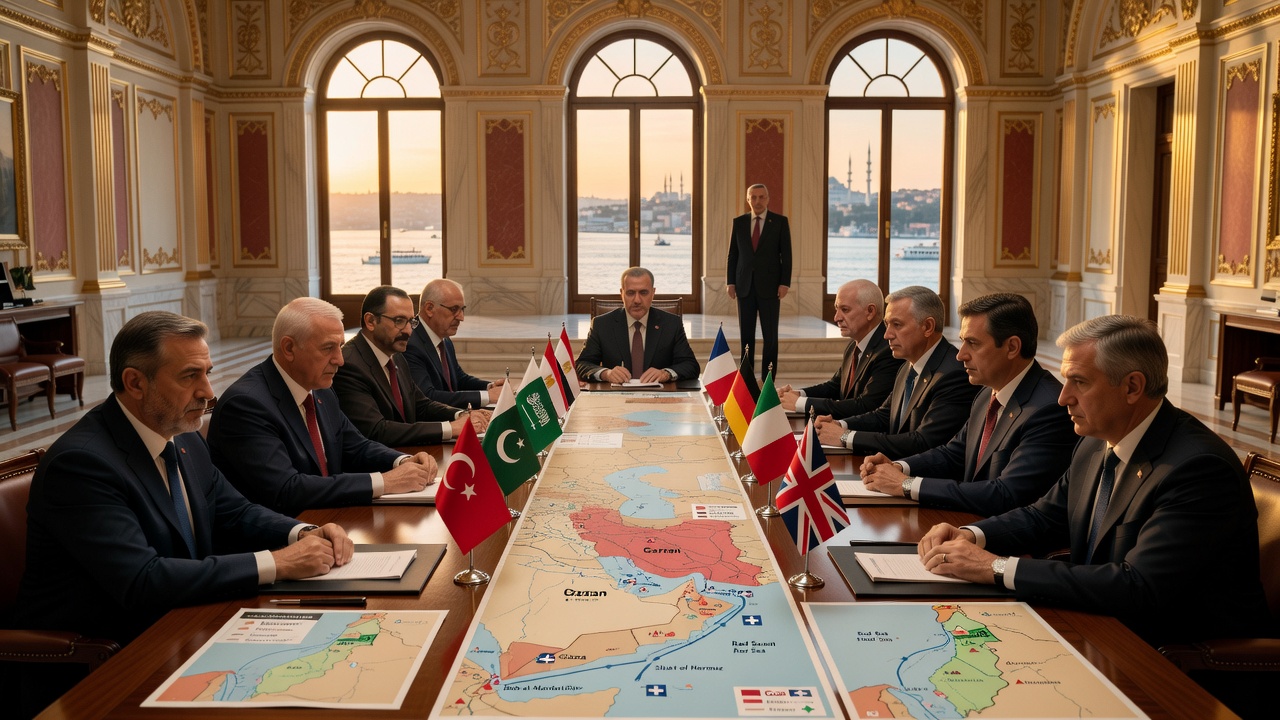
Foreign ministers from eight countries meeting in Istanbul on Oct. 23 urged restraint and negotiated solutions to a cluster of Middle East crises, from the Iran standoff to Houthi attacks on shipping lanes. The gathering, hosted by Turkish Foreign Minister Hakan Fidan, marked the first expansion of the regional R4 Group to include major European powers.
A new diplomatic format takes shape
The session brought together Türkiye, Egypt, Pakistan and Saudi Arabia-known collectively as the R4 Group since its founding in 2026-with France, Germany, Italy and the United Kingdom, a combination participants referred to as R4+E3 plus Italy. Egyptian Foreign Minister Badr Abdelatty, Pakistani Deputy Prime Minister and Foreign Minister Mohammad Ishaq Dar, and Saudi Foreign Minister Prince Faisal bin Farhan Al Saud represented the regional bloc, while French Foreign Minister Jean-Noël Barrot, German Foreign Minister Johann Wadephul, British Foreign Secretary Ed Miliband and Italian Foreign Minister Antonio Tajani represented the European side. It was the sixth meeting of the R4 Group overall but the first in this expanded configuration, following separate talks among the four regional members and a later meeting with Turkish President Recep Tayyip Erdoğan.
Iran, Gaza and shipping lanes dominate talks
Discussions centered on the conflict involving the United States, Israel and Iran; the Israeli-Palestinian conflict; and Houthi attacks threatening vessels in the Red Sea and Bab al-Mandeb Strait. Fidan told reporters afterward that military intervention in Iran would not resolve the underlying crisis and said none of the participating governments currently backs such action. The joint statement called for dialogue to prevent further escalation and emphasized protecting civilians, civilian infrastructure and commercial shipping while pursuing a lasting negotiated settlement.
The ministers also welcomed the Islamabad Memorandum of Understanding as part of ongoing efforts to ease tensions, and stressed the importance of unimpeded navigation through the Strait of Hormuz, a critical corridor for global energy shipments. They warned that disruptions there could strain international supply chains for energy, food and fertilizer, with outsized effects on already vulnerable populations, and called for restoring safe passage without delay.
Houthi attacks and the Palestinian question
The R4 Group separately condemned what it called an unacceptable escalation by Yemen's Houthi militia, pointing to attacks on Saudi Arabia, civilian infrastructure and commercial vessels in the Red Sea corridor. The ministers voiced solidarity with Saudi Arabia and Yemen's internationally recognized government, demanding an immediate end to Houthi military operations and a return to political negotiations.
On the Israeli-Palestinian conflict, the group's statement described Israel's occupation of Palestinian territories as a central driver of regional instability and reaffirmed support for a two-state solution based on the 1967 lines, with East Jerusalem as the capital of a future Palestinian state. The ministers called for an end to settlement expansion, settler violence and changes to Jerusalem's legal status, alongside uninterrupted humanitarian aid and reconstruction in Gaza.
What comes next
Participants agreed to continue meeting in this expanded format, signaling an intent to sustain coordination between Middle Eastern and European governments beyond the Istanbul session. No binding commitments or enforcement mechanisms were announced; the statement reflects shared diplomatic positions rather than new agreements, and its practical effect on ongoing conflicts remains to be seen.