
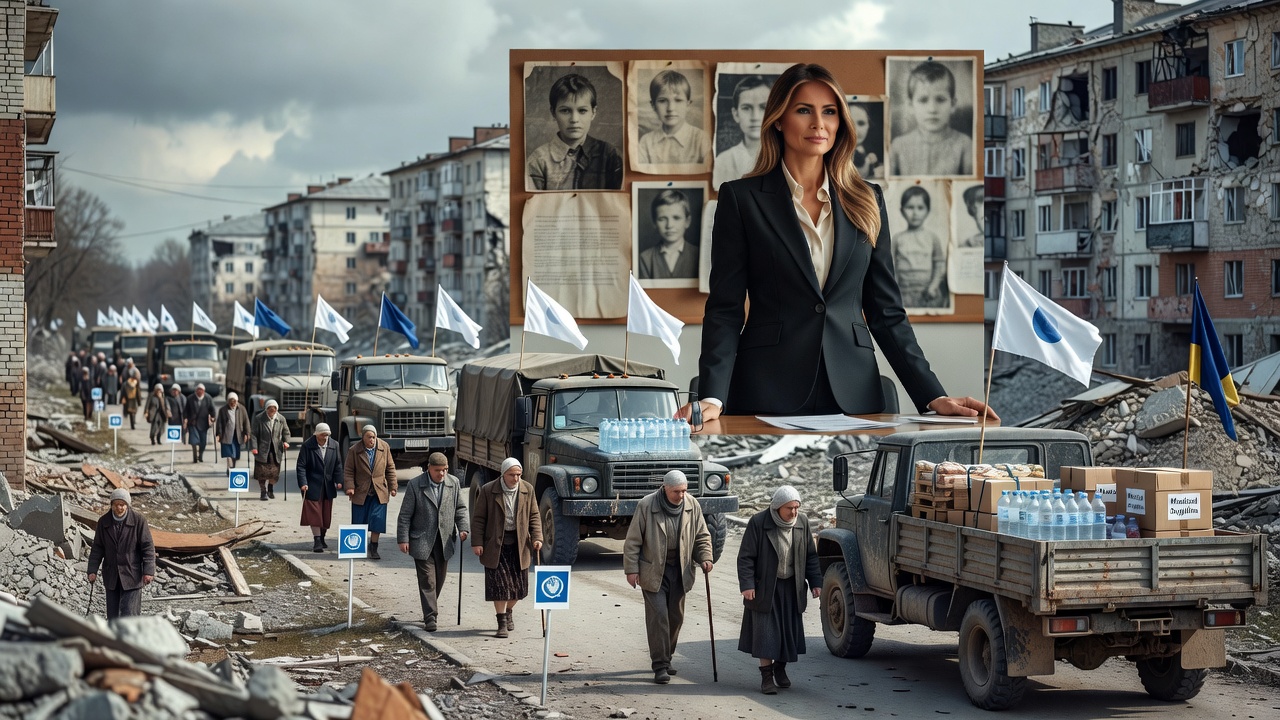
The White House announced Friday that Russia and Ukraine have agreed to a temporary halt in fighting in the occupied southern Ukrainian city of Oleshky, beginning October 29, to allow humanitarian aid in and enable civilians to evacuate. First lady Melania Trump played a role in securing the arrangement, according to the White House statement.
What the agreement covers
According to the White House, both nations agreed to pause military action in Oleshky to permit humanitarian aid to enter the city and to establish a designated safe corridor for civilian evacuation. Oleshky, located in Ukraine's Kherson region, has been under Russian control since Russian forces occupied it in February 2022. The statement did not specify the duration of the pause or the organizations that would coordinate aid delivery and evacuations.
A city in crisis
Residents and local accounts describe worsening conditions in Oleshky, including shortages of food and clean water. Melania Trump, in the White House statement, described the city as "a front-line war city on the brink of disaster," noting that the remaining population is largely elderly and in need of medical attention, medicine, food and clean water. These conditions have not been independently verified by outside monitors in this report, but they align with broader patterns documented in other front-line areas of the war.
Context: the first lady's broader involvement
This initiative follows Melania Trump's earlier advocacy work on the return of Ukrainian children who were taken to Russia during the conflict, an issue that has drawn international attention and criticism of Russia from Ukrainian officials and human rights groups. Her direct role in brokering a localized ceasefire marks a more operational step beyond that advocacy, though the White House statement offers limited detail on how the agreement was negotiated or what mechanisms will verify compliance by both sides.
What remains uncertain
As of this report, it is unclear which humanitarian organizations will manage aid distribution, how evacuees will be screened or transported, and whether the ceasefire will be limited strictly to Oleshky or could extend to neighboring areas. Previous localized truces in the war have faced challenges with enforcement and verification. Observers will likely watch closely to see whether the October 29 start date holds and whether aid and evacuation efforts proceed as described.