
Lab Science Trainees Move From Expectation to Professional Doubt, Study Finds
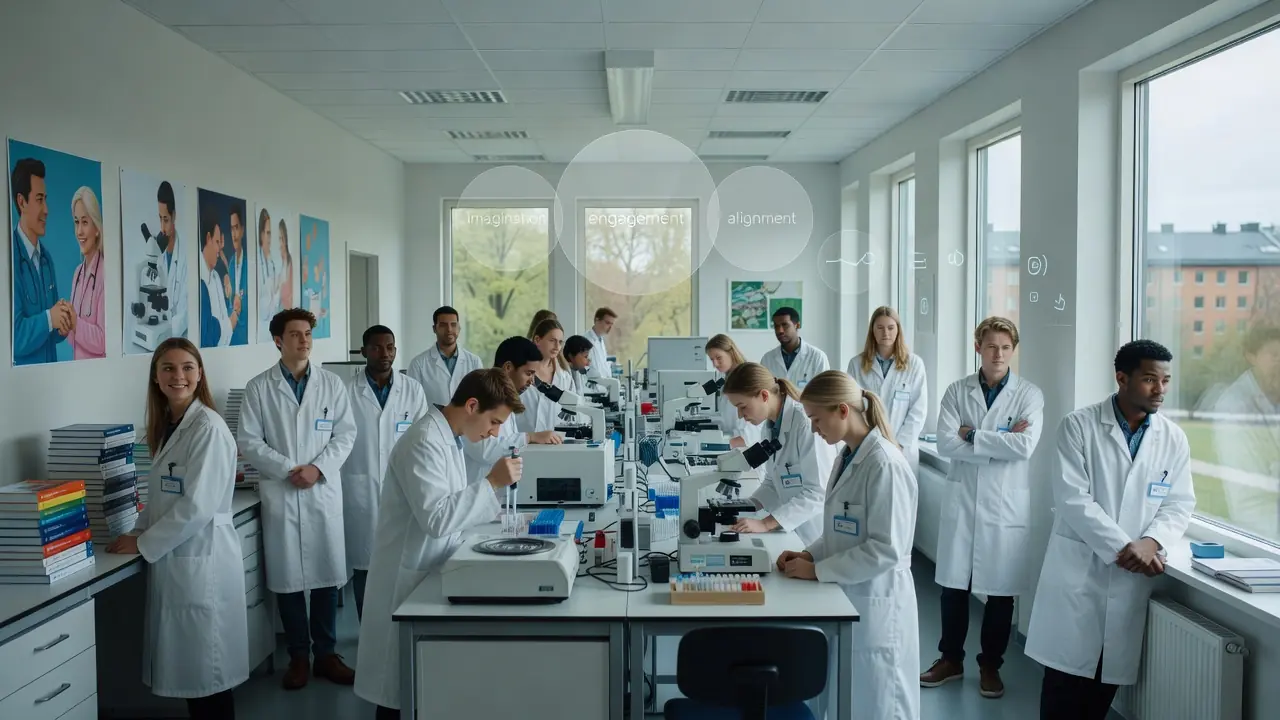
A new qualitative study tracing three years of undergraduate biomedical laboratory science education finds that students' sense of professional identity does not grow in a straight line. Instead, researchers describe a shifting process in which early assumptions give way to hands-on clinical exposure, and eventually to critical self-questioning about whether the career fits.
How the research was conducted
The study, published in BMC Medical Education and led by Amrah Heikkinen, Jenny Flygare, Max Scheja, and Klara Bolander Laksov, examined 24 students enrolled in the first, second, and third years of a Swedish university's biomedical laboratory science program. Participants took part in semi-structured peer interviews using a shared interview guide, discussing their coursework, clinical duties, and evolving sense of professional purpose. Researchers analyzed the transcripts using qualitative content analysis, applying Etienne Wenger's Communities of Practice framework and its three lenses: imagination, engagement, and alignment.
What changed across the three years
First-year students largely understood the profession through imagination, shaped more by preexisting expectations than direct experience. As students advanced into laboratory coursework and real clinical placements, their understanding of daily technical and operational responsibilities deepened substantially through direct engagement. By the final year, many students showed stronger alignment with the profession's core values, actively weighing their future roles within the broader biomedical community. Notably, this progression was not uniformly reassuring: clinical and academic experiences prompted some students to engage in critical self-reflection, with a subset reporting a sense of distancing from the profession as they reconsidered their long-term occupational fit.
Why it matters for training and practice
The authors argue that these intertwined processes of imagination, engagement, and alignment are not incidental to education but foundational to building workplace competence. They connect this developmental trajectory to broader healthcare outcomes, suggesting that how well students internalize professional values and practical skills during training can influence diagnostic quality and patient safety once they enter the workforce. The findings point to a practical implication for educators: pairing classroom instruction with structured clinical placements appears to support not just technical skill-building but also the kind of critical reflection that helps students clarify-or reconsider-their career direction before graduation.
Limits of the findings
This was a single-institution, cross-sectional study of 24 students in Sweden, and the authors frame it as exploratory rather than definitive. The peer-interview method and qualitative design offer rich detail on individual perspectives but do not establish how common professional distancing is across broader student populations or other countries' training systems. Readers should treat the results as an evidence-based starting point for discussion among educators rather than a universal description of how all laboratory science trainees develop.