
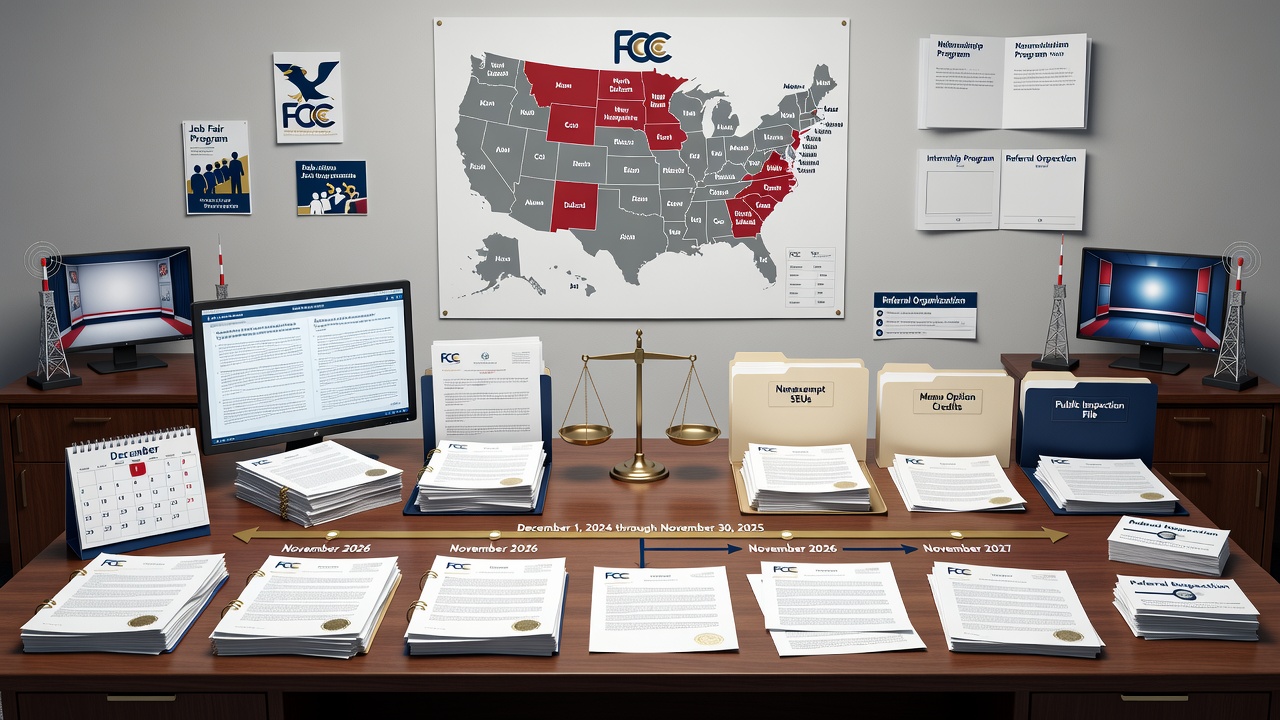
Radio and television stations licensed in Alabama, Colorado, Connecticut, Georgia, Maine, Massachusetts, Minnesota, Montana, New Hampshire, North Dakota, Rhode Island, South Dakota, and Vermont must file their Annual EEO Public File Report by December 1, 2025. The requirement, set by the Federal Communications Commission, obligates stations to document their equal employment opportunity activities over the preceding year and make that record publicly accessible.
What the FCC rule requires
Under the FCC's Equal Employment Opportunity Rule, every broadcast station employment unit, regardless of size, must provide equal opportunity to qualified job applicants and avoid discriminatory practices. Stations with five or more full-time employees, classified as "Nonexempt SEUs," face additional outreach duties. These include widely publicizing full-time job openings, notifying referral organizations that request vacancy alerts, and earning a minimum number of "Menu Option" credits through activities such as job fairs, internship programs, or community outreach initiatives, tracked across two-year segments of a station's eight-year license term.
Filing mechanics and recordkeeping
Nonexempt SEUs must place the completed report in the Public Inspection Files of all stations under their umbrella and post it on each station's website, where one exists. Low-power television stations, though not required to maintain a Public Inspection File, must still prepare the report and retain it in a station records file available to FCC inspectors on request. The report due this year covers the period from December 1, 2024, through November 30, 2025, though stations may shorten that window by up to ten days if they adjust the following year's reporting period accordingly.
Menu Option credit timelines vary by state
Because license renewal filing dates differ by state, the two-year segments governing Menu Option credit requirements are not uniform across the listed jurisdictions. Radio stations in Alabama, Connecticut, Georgia, Maine, Massachusetts, New Hampshire, Rhode Island, and Vermont fall under a segment running through November 2027, while those in Colorado, Minnesota, Montana, North Dakota, and South Dakota must have already satisfied credit minimums for a segment ending in November 2026. Television stations in those same state groups follow similarly staggered but distinct timelines. Stations with five to ten full-time employees, or located in smaller markets, need at least two credits per segment; larger-market stations with eleven or more employees need at least four.
Why documentation matters
The FCC credits only initiatives that are properly reported and backed by adequate documentation, making thorough recordkeeping essential before a report is finalized and publicly posted. The agency also conducts random compliance audits each year, reaching roughly five percent of all broadcast stations, meaning any station could face scrutiny regardless of past filing history. Legal review of draft reports before public posting is a common safeguard broadcasters use to reduce compliance risk.